

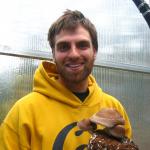
Adam Gold
Adam is the owner of Salt Spring Exotic Mushrooms. He grows culinary mushrooms for the region as well as grows and extracts medicinal mushrooms. He has a B.A. in Environmental Policy and Law and Business. His passion is homesteading and he enjoys growing and processing animals, making wine, fermenting vegetables and music. Six years ago he and his partner Rebecca Bloch started the Funky Revolution Farm, on Salt Spring Island. They built and maintain a diverse and very successful permaculture landscape that supplies them with vegetables, fruit, flowers, mushrooms, meat, medicinal herbs, water, timber and income 12 months a year. His newest passion is orcharding. He is in the process of planting an organic orchard, to enjoy and share for generations.
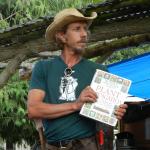
Brandon Bauer
Brandon has been studying Permaculture for 16 years and is actively applying Permaculture on various sites on Salt Spring Island and abroad. Over the last 8 years he has participated in teaching Permaculture Design courses at O.U.R. Ecovillage, The Bullock Brother’s Permaculture Homestead, UBC and at The Blue Raven Farm. He is a naturalist, organic farmer, biodiversity specialist, seed saver, herbalist, and soil scientist. He is the co-creator of The Blue Raven Permaculture Farm on Salt Spring Island. He is currently working with Salt Spring Seeds and Anderson Greenplan. Brandon sees permaculture as one of the most inspiring and action focused ways to live. He contiues to practice what he teaches farming on Salt Spring Island, supporting local food and enjoying many lakes of the island with his family.

Connie Kuramoto
I have had a variety of adventures throughout my decades in Horticulture. In the fifties I was helping my parents in their large food garden. In the sixties you could find me selling flowers on the street corner in New Mexico, after becoming frustrated with my formal Education in Botany at the University of Massachusetts. The seventies found me farming a small market garden in Ucluelet on 7 acres of land and selling mini greens to the local restaurants before you could buy them in the grocery store. I also raised over 200 free range chickens on my acreage for both meat and eggs. In the early eighties I worked in greenhouses in the Vancouver area, and earned a Certificate in Floral Design from Kwantlen College. The mid eighties found me in the fishing industry, and then going on to continue my horticulture education at Malaspina College and earning my Diploma in Greenhouse Horticulture.
I obtained work as a work study and summer student for the college for two years before getting hired as a technician and instructor. My job there was to manage 10,000 square feet of greenhouse and a small outside nursery and garden and to coordinate student activities in the greenhouses and gardens. I also taught plant propagation and horticultural skills and practices. Although the majority of my career was spent at Malaspina I also worked part time as interior plant landscape technician, as a floral designer, and a gardener and garden writer and consultant. Most recently I was hired by North Island College to teach a horticulture therapy program to persons living with mental illnesses.
I have been active in community groups, including Nanaimo Community Gardens, Mc Seeds Farm for Persons with Disabilities, Pesticide Abatement Nanaimo, and the Open Minds Open Windows Wellness Program for persons living with Mental Illness. In my spare time I paddle and coach dragon boat teams, and love to cook and garden.
I have just purchased a small acreage in Qualicum, and am looking forward to turning it into a permaculture paradise. I have two wonderful daughters who have absorbed more than they could ever imagine about plants without even knowing it!
- Botany studies, University of Massachusetts
- Diploma in Greenhouse Horticulture Technology, Malaspina College
- Naturescape Ambassador
- Floral Design Certificate Kwantlen College
- Owner Operator “Gardens on the Go” Horticultural Services and Training

Curtis Stone
Before starting his urban farm in the fall of 2009, Curtis had absolutely no previous experience in farming or even gardening. Up until 2008, he had been living in Montreal as a musician, playing in a band called People for Audio. It was over 15 years ago, when he heard the old cliche, “if you’re not part of the solution, you’re part of the problem”. That was a turning point for him in that he knew that it was important for us to be active participants in our society, rather than just being by-standers. But it wasn’t until Curtis discovered a thing called Permaculture, while searching around on the internet for sustainable building methods, that it opened up a Pandora’s box of information and inspiration for him.
From there, he knew that he wanted to live in a way that was life affirming, not destructive. He left Montreal in March of 2008 to return to his home town of Kelowna, BC, to try and pursue this kind of life style. It was a bike tour down the west coast from Kelowna to San Diego in fall 2008 where he visited off-grid homesteads, eco villages, and urban farms, that inspired him to try to make a difference through his own actions. Upon returning from the trip totally inspired and ready to do something involved in sustainable ag, but not exactly sure what yet, a friend of his directed him towards SPIN farming. The stars must of aligned at that movement because once Curtis discovered that there was a way to farm that required very little investment, no need to own land or heavy machinery, he was confident that he could do it. He spent the rest of the fall and winter of 2009 studying SPIN farming and various other gardening and farming books, and then decided to go for it. With a little bit of money saved from a 6 month season of tree-planting, he had everything he needed to start a farm. After completing a successful and profitable first season in 2010, Curtis is a case study example that the methods taught in the SPIN farming models, are simple and easily transferable to anyone, including those who have no experience.
Through the off-season, Curtis works as public speaker on food related issues, and is a consultant for multiple community food projects throughout Kelowna. In September 2010 he was awarded ‘gardener of the year’ from the city of Kelowna’s Communities in Bloom.

Dan Halsey
A certified permaculture designer and teacher for the Permaculture Research Institute, Cold Climate. Daniel graduated from the University of Minnesota with a Bachelor of Science degree in Temperate Climate Polyculture Design and is currently a graduate student working on his Masters degree and a graduate research assistant. His interest in agro-ecosystems and edible forest gardens began with an introduction to polyculture design in 2003. Polyculture plant systems are patterned after forest ecology where each plant contributes to the health of the ecological niche and soil community.
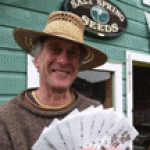
Dan Jason
A passionate gardener since he planted his backyard in Montreal at age 13, Dan Jason is committed to empowering people to grow their own food and save their own seed. Since 1976 he has lived on Salt Spring Island, BC, where he created the mail order seed company Salt Spring Seeds, which specializes in heritage and heirloom open-pollinated and non-GMO seed varieties of vegetables and plants.
Dan was strongly involved in Seeds of Diversity Canada in the early years, and founded the Seed and Plant Sanctuary for Canada in 2003, which he now heads. Dan has written many books, including his most recent Saving Seeds as if Our Lives Depended on it. As an active critic of genetically modified seeds, patents on living organisms and industrial agriculture in general, he is a dedicated educator on sustainable organic gardening and farming, food politics, seed saving, and a farmer of beautiful gardens full of vegetables, grains, medicinal and culinary herbs and flowers.
Dr. Karin B. Kilpatrick
M.B.ChB (Cape Town) C.C.F.P. (Canada)
Karin was raised on a farm in South Africa in the 1960s, the oldest of four children. She completed her medical degree at the University of Cape Town in 1981, followed by a four-year intensive residency program at a teaching hospital in South Africa, which services the indigenous population of a large, under-serviced rural area. After this rich, cross-cultural experience, she traveled through Sub-Saharan Africa. Then in 1986 she decided to locum in Saskatchewan, Canada, where she met and married a prairie farmer. Fully participating in the grain and cattle farming she enjoyed raising her two daughters while continuing to practice GP medicine, as well as Obstetrics and Anaesthesia in her prairie community.
In the year 2000, Karin and her two, then teenage, daughters, Lara and Montana, moved to Christina Lake, BC. Over the next decade she enhanced her skills and her practice became more integrative, with a strong mental health component. She particularly enjoyed her advocacy and consultancy work with high-risk mothers, as part of a collaborative multi-disciplinary team from the Boundary Family and Individual Society, a non-profit organisation.
Presently she lives in Osoyoos, BC with her partner, Richard Walker, who is a food forester and a herbalist. Karin continues to practice integrative medicine, actively advocating for self-managed health and wellness, and is writing her first novel. Her passion continues to be the peaceful reclamation of wellness and empowerment for individuals as well as for communities.

Geoff Johnson
Geoff graduated from Linnaea Farm’s permaculture design program in 1995, and has focused on studying, practicing, and teaching urban permaculture ever since. Over the past decade he has worked and volunteered with a variety of local organizations to develop several urban agriculture demonstration sites (including the area’s first edible park, Spring Ridge Commons).
In Victoria, Geoff was the orginator and drive force behind Canada’s oldest public food forest, Spring Ridge Commons. This premier site for regenerative agriculture for the public has been visited by over 20,000 people over the last 12 years of being a living laboratory for food, medicine and functional plants.
As site educator at the Compost Education Centre (1999-2005) he launched his teaching career by developing and instructing a series of educational workshops on the practice of urban homesteading. He now teaches “Introduction to Urban Homesteading” through the continuing studies dept. at the University of Victoria.
Abroad, Geoff has participated in several community agriculture projects in locations ranging from Australia to the Indian Himalayas, but has avoided both air travel and the fiction of carbon credits since 1998.
Geoff completed a six month internship at the Bullock’s Permaculture Centre in Washington state.
Currently, Geoff continues to develop the 1560 Pembroke Urban Homestead. Versed in both hard strategies (water catchment, greywater use, passive solar design, solar hot water, hueguelkultur, greenhouse use) and soft (guilds, crop rotation, pruning, grafting, propagating, seed stratification, and more). He recently started top bar hive beekeeping and no-treatment methods.
Geoff brings his knowledge and permaculture plant cornucopia nursery successes and failures to students to shave a few years, or at least a few less dead plants off their progress in growing a diverse backyard oasis that provided habitat, food, medicine, fuel and fibre for city folk. His bike-powered nursery in Fernwood provides the local area with hard to find and propagate food, medicinal and functional plants and trees.
To contact him about his plant stock email at respectyouralders@yahoo.com

Javan Kerby Bernakevitch
Javan is driven to provide the right balance of theory, practical experience and integration of community to ensure students retain, use and leave Permaculture BC educational opportunities prepared and inspired to take positive action.
Versed in construction, natural building, environmental education, group facilitation and organic gardening, Javan offers a unique balance of content-focused education with student-centered learning. His recent work includes the food forest enhancement of Fernwood NRG Community Centre, the Vic West Food Security Association’s Hereward Park Food Forest, consulting with BC’s most experienced food forester Richard Walker, Michael Nichels’s Seven Raven’s Ecoforestry Farm, the creation of the Southern Vancouver Island Permablitz Network, designing and teaching for OUR Ecovillage producing students, bioregionally appropriate greywater and natural building systems.
Javan continually aspires to spread the lessons of Permaculture through Vancouver Island Permaculture Community and Meetup Group, articles for Urban Garden and other publications. He received his permaculture Instructors Certificate from Jude Hobbs Cascadia Permaculture Institute and his Permaculture Design Certificate at OUR Ecovillage. He actively teaches permaculture across Canada and the USA, designing and blistering his hands on many a tool and implement.

Meghan Loop
Livestock, Permaculture Instructor, Organic Gardening, Zero Mile Diet
With a foundation in family farming and sustainable food production, Meg Loop is recognized within both community and academic circles for her passion as a change agent in the permaculture network. With a focus on livestock, soil fertility, fibre arts, and whole systems understanding, Meg is now working in sustainability education and practice.

Michael Nickels
Most of the year Michael Nickels can be found at Seven Ravens Farm, which he runs with his wife Heidi Cowan and their two children, Abbie (13) and Quinn (2) on Salt Spring Island, BC. But each winter, Michael visits Kenya to supervise and help the tree nurseries and permaculture gardens he has established over the last seventeen years. This article is about the permaculture operation at Seven Ravens Farm, the Salgaa Community Education Project in Kenya, and the farmer who transforms lives and land through his skill with trees.

Rebecca Bloch Gold
Rebecca has been farming professionally for over a decade. She has worked in both large and small-scale organic agriculture, co-op farming, CSA and homesteading. She has a technician’s degree in Horticulture and a B.A. in Environmental Agriculture. She has been involved in Salt Spring Island’s “Plan to Farm” initiative as well as the SSI Community Services “Theraputic Garden.” Six years ago she and her partner Adam Gold and her family started the Funky Revolution Farm, on Salt Spring Island. They built and maintain a diverse and very successful permaculture landscape that supplies them with vegetables, fruit, flowers, mushrooms, meat, medicinal herbs, water, timber and income 12 months a year. Her newest passion is the field of “emotional sustainability” living and maintaining our right livelihoods.

Richard Walker
Richard is a food forester, designer, herbalist and teacher with over 25 years experience. He has designed community and private forest gardens throughout BC. He spent his early years as an organic farmer in Alberta. He later moved to Grand Forks, BC where over 20 years he transformed his 3 acre property from a bare horse pasture into a lush self-sustaining forest garden with over 400 nut trees and seven storeys of food and medicine bearing perennial plants and vines. Having converted a degraded piece of land into an abundant mix of rare, unique nut, fruit and medicinal plants from all over the world, he is one of Canada’s most experienced food foresters. Richard shares his studied and practical experience in a respectful and approachable manner to inspire grower enthusiasts and save many from years of trial and error.
He also has a great depth of herbal medicine knowledge and has developed herbal medicinal tinctures and teas for over 25 years. He shares his knowledge of plant biology to promote healthy living through the philosophy of food and herbs as medicine.
What really adds to Richard’s credibility is that he lives as he teaches. He lives simply, creatively using his skills to bring food from the soil, to the table, and in doing so teaches us how food and plants create a culture of true sustainability. In his own words “gardening for a 1000 years”.
He loves to share this vision as a model for communities and individuals who are inspired to grow themselves in environmentally friendly, self-sustaining ways.
2010 – Present Establishing a food forest on a half-acre arid zone lot (Osoyoos, BC)
1984 – 2009 Established the first food forest in Canada (Grand Forks, BC)
1988 – 2003 Established and operated an edible landscape nursery (Grand Forks, BC)
1973 – 1993 Farmed organically (Tofield, AB)
1973 – Study of herbal medicine and development of herbal medicine tinctures and teas
2009 – 2010 Designer and Consultant for the Clear Sky Food Forest (Clear Sky Meditation and Study Foundation, Cranbrook, BC)
1994 Designer and Consultant for the Salmo Food Forest (Salmo Town Council, Salmo, BC)
1992 Designer and Consultant for the first urban food forest in Canada (Earth Matters, Nelson, BC)
2010 Vancouver Urban Permaculturalists, Vancouver, BC
2010 Society for Organic Urban Land Care and Gaia College, Victoria, BC
2010 Society for Organic Urban Land Care and Gaia College, Nanaimo, BC
1992 – 1993 Herbology Presenter (Okanogan College, Penticton, BC)
1990 – 1994 Forest Food Design (Earth Matters, Nelson BC)
1989 – 2006 Herbology (Selkirk College, Grand Forks, BC)
2011 Permaculture BC – Victoria, BC
2010 Society for Organic Urban Land Care and Gaia College – Nanaimo, BC
2010 Clear Sky Medication and Study Foundation – Cranbrook, BC
1990 – 2009 Past President and one of three founding members of Boundary Organic Producers Association (BOPA)
1990 – 2009 Member, Organic Certifying Committee, appointed by BOPA